


As a dentist, sometimes the most meaningful cases arrive unexpectedly. In a spur-of-the-moment decision, a patient will abruptly opt to address an insecurity.
We’ve all seen it: the decades-old broken tooth, the discoloration, or the imperfection that is now their sole focus. What triggered the impulsive need to fix the issue at hand may remain a mystery; however, dentists now have another technique in their arsenal to solve a restorative case. With the right materials, workflow, and clinical skillset, that same patient can leave the office not only restored but genuinely changed. Universal shade composites have become a powerful tool in these moments, offering predictability, efficiency, and esthetic results that can turn a last-minute consult into an immediate, trust-building outcome.
One Saturday morning, my office received a call from a new patient. After years of dissatisfaction with her front teeth, she impulsively decided to address it. A Google search led her to my operatory just one hour prior to closing.
“I just want to see what my options are, and I can come back,” she inquired.
With evening plans confirmed and a last-minute appointment, her expectations were non-existent. Exam findings included Class V caries along the gumline of #8 and #9. At age 27, she said it had been years since she had smiled fully. I asked her to clarify what she meant. She explained fully smiling as one of those ear-to-ear, dimple-contouring, eye-twinkling smiles.
No problem. “Let’s see what our options are,” I explained, while knowing full well that she could leave today confident and fully smiling.
This is where the power of universal composites distinguishes itself. Anterior resins are notoriously ideal for shade matching. The value of having a predictable workflow in my armamentarium is immeasurable. A cosmetic insufficiency that had lingered for years was now myopic enough to warrant a same-day appointment. Addressing her insecurity promptly is an opportunity that many dentists will let slip from their grasp by rescheduling. In that one hour, we can shatter expectations. She can depart beaming and elated, with complete faith in her dentist. A complete transformation in a patient’s disposition is not only plausible in such a short time, but is, in fact, probable and predictable.
I opened my portfolio. “Let me show you what you can leave with today,” I explained, as we scrolled through case photos together for ones similar to hers. Good dental photography, used effectively, can build a patient’s confidence in their dentist. A picture is worth a thousand words, but for dental patients, a picture is worth at least ten thousand.
My recommendation was to restore both tooth #8 and tooth #9 with direct resin veneers. The goal was threefold: replace missing tooth structure, protect the incisal edge from further damage, and improve esthetics. I stepped out of the room, and Christine, my assistant, was bombarded with questions. Will it last? Are the photos real? Can this really be done today? Christine reassured her.
Consistency is crucial for repeatability. In this case, post-caries excavation, the dentin shade appeared both uniform and consistent, with a gradient from the gingival margin extending apically to the incisal edge, precluding the need for a blocking resin. The shades were evaluated with and without fluorescent light for accuracy. In this case, both #8 and #9 were restored exclusively with packable OMNICHROMA composite and refined with the Shofu Rainbow Polishing Kit.
The results speak for themselves. She described the final reveal as “wow,” “incredible,” and “I’m never seeing another dentist.”
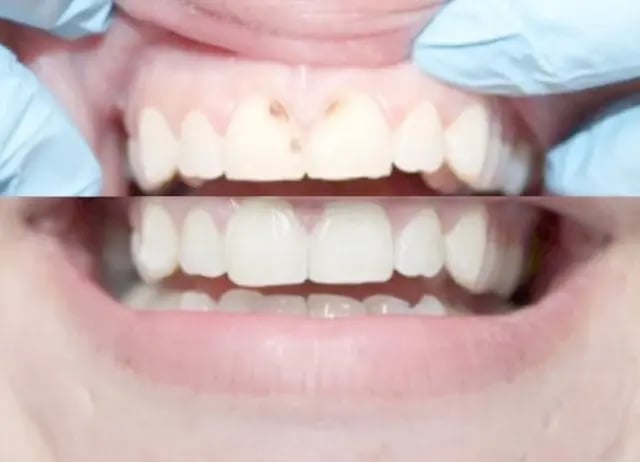
This is the magic of single-shade resin direct restorations. Exceeding expectations is one of the fastest ways to earn trust in the provider and the treatment. This leads to stronger rapport, better case acceptance, loyalty, more referrals, better outcomes, and a reputation that grows through real patient satisfaction. A single unexpected visit can earn a patient for life.