

How difficult can a one-surface restoration be? If you’ve been in dentistry long enough, you know a procedure code or classification can only tell you so much about what you’ll encounter clinically.
Lately, I’ve been finding a wide variety in presentation of class V lesions at my practice, and I’m glad to have found a restorative protocol that makes treatment much more predictable. Tokuyama Dental’s OMNICHROMA composites allow me to efficiently and effectively manage these lesions.
Class V lesions arise from a variety of etiologies. In cases of bacterial origin, poor oral hygiene results in carious lesions along the gingival margin. Other times, dietary or gastric acids cause erosion of the thin enamel layer at the tooth cervix. Yet another etiology is biomechanical, where traumatic forces perpendicular to the long axis of the tooth cause cervical abfractions in response to flexural pressure. Lastly, patients present with recurrent decay and marginal leakage on existing restorations, and conservative management by directly treating these areas may be preferable to removing the entire restoration. In other words, there is no “typical” class V lesion.
Combined with these etiologic factors, these lesions have challenging esthetic demands. They are often in highly visible areas of the mouth—buccal surfaces of anterior teeth. In particular, patients with high smile lines and broad gingival display require outstanding esthetic results. The anatomy of the region complicates the esthetic picture. In the cervical area of teeth, the enamel matrix becomes thinner over the dentin until disappearing completely at the cementoenamel junction, after which cementum covers the root’s outer surface. Cementum, dentin, and enamel have drastically different chroma, value, hue, and translucency, so it is challenging for restorations to transition gracefully across the cervical area of the tooth.
As if that were not enough, these restorations require exacting technique. Isolation is challenging at best—saliva, gingival crevicular fluid, and blood must be managed. Traditional isolation methods such as rubber dams and gingival cord may not be sufficient. Restorations must have excellent marginal seal and high polishability to resist staining and recurrent decay.
While there are no one-size-fits-all solutions in dentistry, I have repeatedly found myself turning to OMNICHROMA composites to manage these class V situations. The original universal shade composite, OMNICHROMA seamlessly blend into the shades of existing tooth structure to deliver predictable, outstanding esthetic results.
The OMNICHROMA composite family is refreshing in its simplicity. There are no shade clusters or values from which one needs to choose. It is compatible with any enamel etch and composite bond. It has mechanical properties (flexural and compressive strength, polishability, bond strength) comparable to other composites, making it suitable for any indication.
What OMNICHROMA does offer, however, is flexibility. It is available in packable, flowable, and bulk flowable formulations—and I often layer them to suit my handling preferences. It also offers an optional BLOCKER that I use to cover very dark stains or to add opacity to thin incisal edges.
For class V restorations in particular, it eliminates much of the guesswork and headaches. It displays a gradual gradient when transitioning from coronal to apical portions of teeth, delivering very esthetic results. If the patient later decides to whiten their teeth, or if the teeth darken over time, the restorations will change shade to match. If I have multiple class V lesions to restore, I can stick with the same composite for each of them—no need to pull out the shade guide. This allows me to minimize chair time—good for patient comfort and office profitability.
Here are some tips for a successful class V restoration:
-
Create a facial bevel onto enamel. This allows the composite to make an ideal contour,minimizes staining at the restoration margins, and increases retention.
-
Excavate conservatively. Stained dentin and cementum is not necessarily carious, and itcan always be blocked out to deliver an esthetically pleasing result. Avoid traumatizingthe gingiva to make your life and the patient’s life easier.
-
Manage moisture at the site. Contamination results in weaker bond strength,intrinsically stained restorations, or pitting at the surface and margins. I find thatinfiltrating the marginal gingiva with local anesthetic pushes fluid out of the tissues, afterwhich I can use retraction cord to keep things dry.
-
Finish with flowable. In my hands, applying a thin layer of flowable composite at thesurface of the restoration helps blend the margins and reduces polishing time.
Done correctly, class V composites can be the direct restorations that make the most dramatic impact on a patient’s dental health and esthetics. With the proper tools and techniques, you can turn conundrums into confidence-builders.
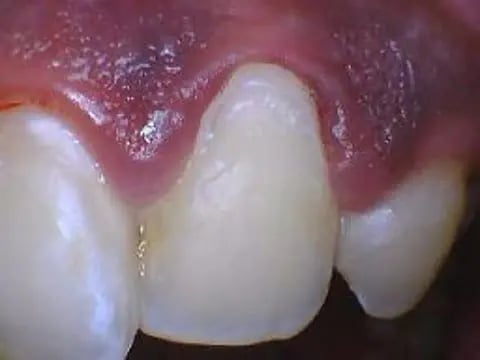
Photo 1: This geriatric patient presented with large abfractions on #10 and #11.
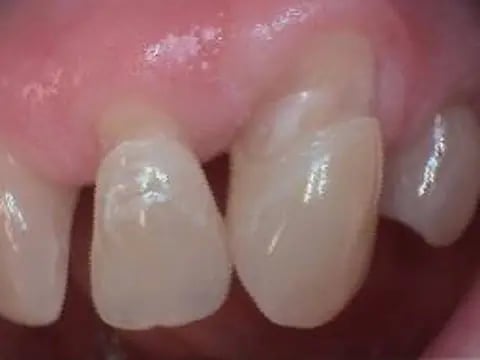
Photo 2: The restoration was completed with OMNICHROMA Blocker, OMNICHROMA, and OMNICHROMA Flow.
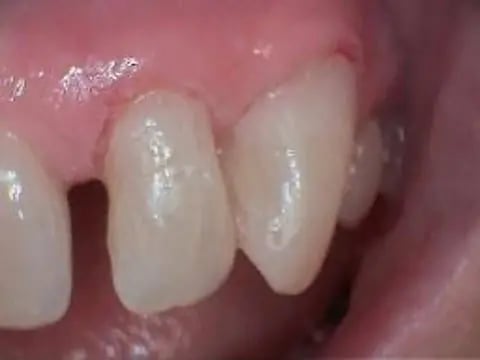
Photo 3: This patient presented with demineralized enamel and caries on #10.
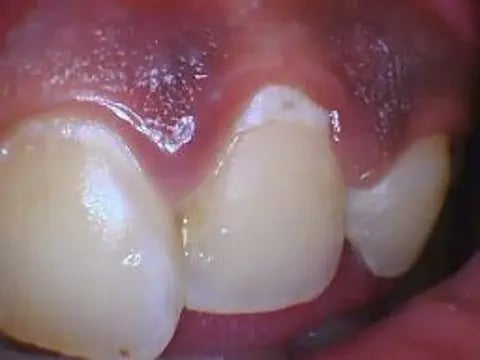
Photo 4: The restoration was completed with OMNICHROMA Flow.